
Incident Response & Recovery
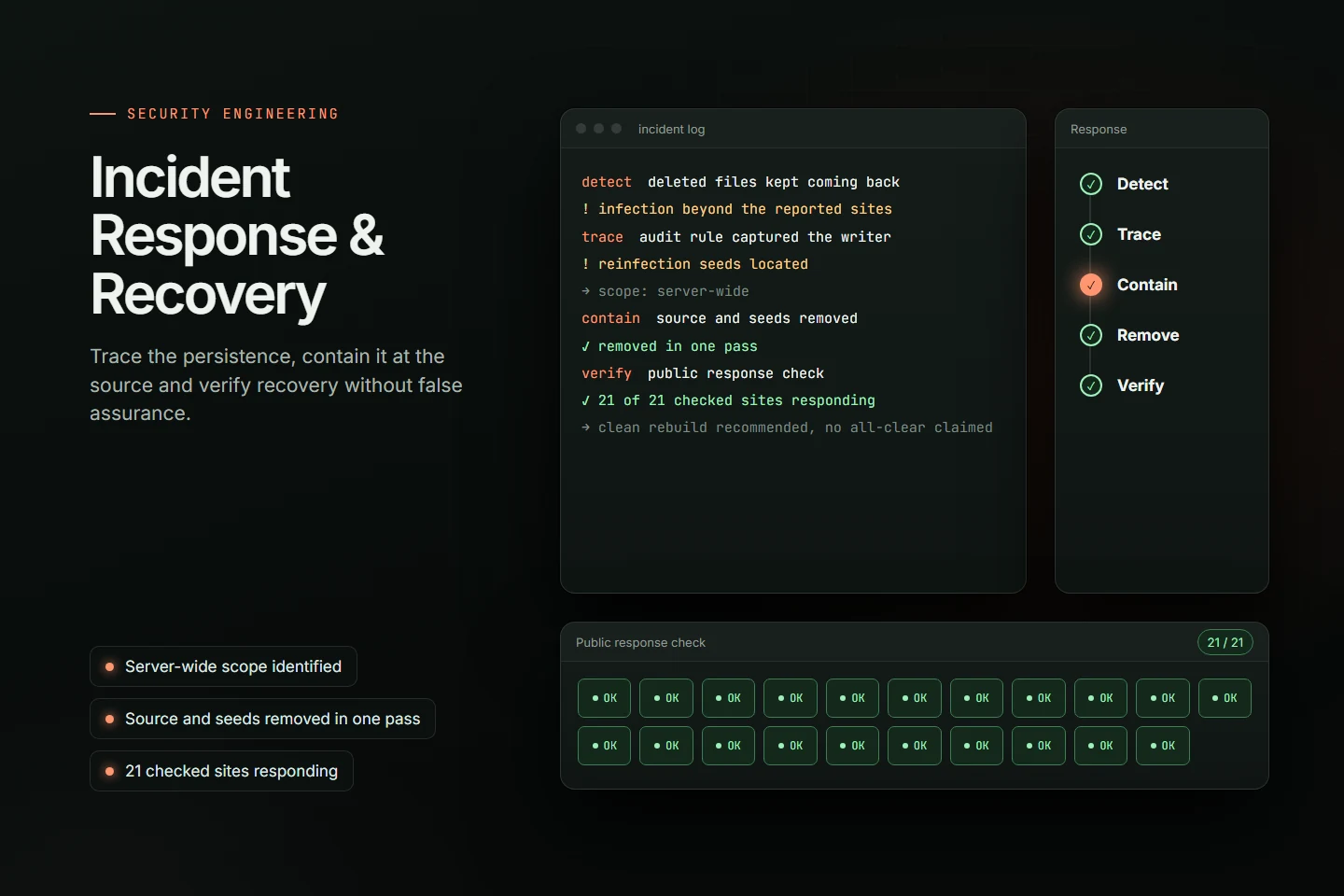
Found and contained a self-repairing WordPress infection, then proved recovery with a full rescan of 114 WordPress installs.
Client engagement · reinfection contained October 16
Client project · Name withheld
Multi-site WordPress hosting client. The client is kept anonymous to protect the affected business.
THE ENGINEERING
A backup-first response to a multi-layer WordPress compromise. Process inspection and writer tracing expanded the investigation beyond known filenames. Repeated scans found zero known indicators after containment, and 21 checked sites returned successful public responses. On October 16 a new infection on the same hosting account was found and contained: five malware runners stopped, 79 artifact files and six hidden token APIs quarantined, rogue users and 53 persistence rows removed, and seven database credentials, nine administrator passwords and seven key sets rotated. A full scan of 114 WordPress roots and 119 option tables then found zero artifacts, and a real administrator login passed with 21 regression tests. Successful containment is distinct from rebuilding a historically compromised environment from a trusted image.
BEFORE → AFTER
Real problems from this build, what I changed and the verified result.
- CASE 01Before
Deleted files came back within seconds, and a site could return HTTP 200 while malicious code still ran.
AfterThe source and its seeds were removed in one pass instead of another round of symptom deletion.
How I fixed itTreated regeneration as evidence of an unresolved source and used a temporary audit rule to capture the actual writer.
- CASE 02Before
Filename scanning proved infection but could never prove absence, so the first reported scope was too small.
AfterThe compromise was shown to be server-wide, not limited to the reported sites.
How I fixed itSwitched to structural classification plus process inspection across account boundaries.
- CASE 03Before
On October 16 the malware came back: five runners, 247 rogue accounts, 274 spam posts and loaders the earlier detector missed.
AfterA full scan of 114 WordPress roots and 119 option tables found zero artifacts; a real admin login passed with 18 access checks and 21 regression tests.
How I fixed itPreserved evidence first, stopped the runners, quarantined 79 artifacts and six token APIs, and rotated every affected credential, not only the infected files.
Evidence reviewed: Anonymized technical case study, August 26, 2026